

Introducing EMMANET: A New AI Architecture
2026年11月04日
At Syntheva Robotics, we've always believed that truly capable humanoid companions need more than simply running an existing AI model inside a robotic body. Creating robots that remember, learn from experience, adapt, and gradually develop their own individual characteristics calls for a different approach to artificial intelligence.
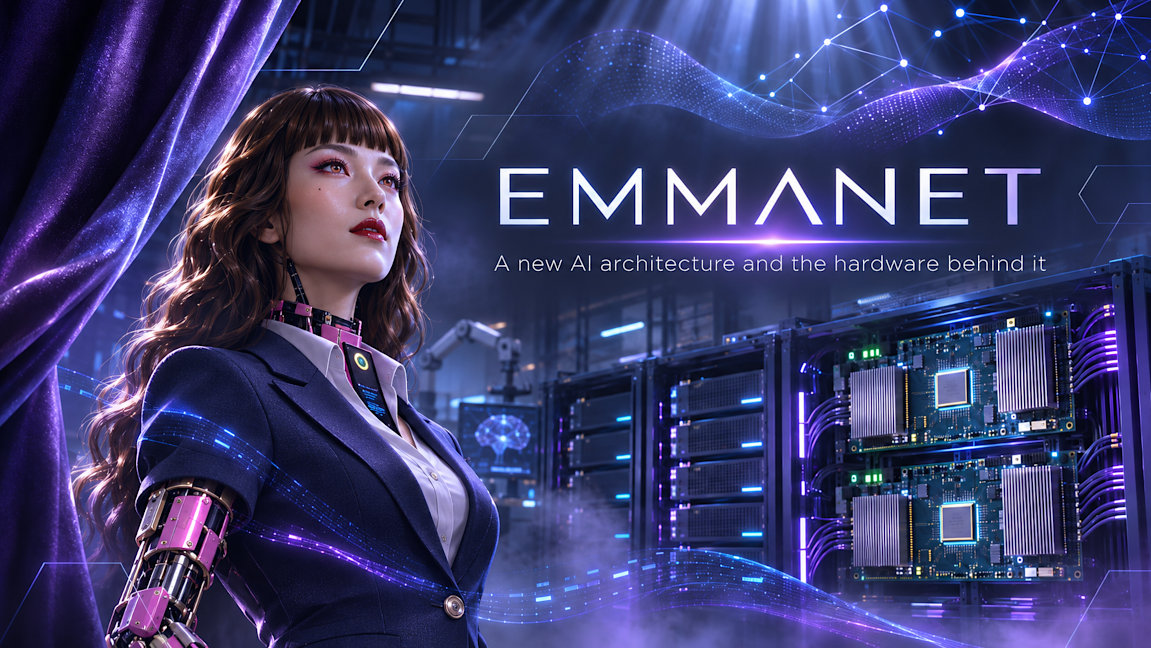
That's why we've been quietly developing EMMANET, our proprietary neural network architecture, designed specifically for long-term, adaptive AI in humanoid robotics.
EMMANET is the result of extensive in-house research and experimentation, and forms the neural foundation of our EMMA emotional AI system.
What makes EMMANET different from conventional architectures? Well, we're keeping that under wraps for now. Let's just say we've been exploring some rather unconventional ideas — and we'll be revealing more in an upcoming technical announcement!
Not Your Typical AI Training Rig
Developing an unconventional architecture also calls for some unconventional hardware.
Rather than relying exclusively on traditional GPU-based computing, we've built our own heterogeneous AI research and training platform, combining conventional high-performance GPUs with large, reconfigurable FPGAs and substantial RAM/VRAM arrays.
The FPGA subsystem runs EPIA (Easily Parallel Instruction Architecture), our open-source NPU architecture, now extended with a new training configuration.
While EPIA's inference capabilities have already been presented publicly, its training-oriented extension represents another exciting direction in our hardware research.
Together, these technologies give us the freedom to experiment with both neural network design and the underlying computational hardware, without being limited to conventional GPU-only approaches.
A New Standard for Our Robots
We're also excited to announce that from now on, all Syntheva robots will run EMMA with EMMANET as the default neural network architecture, featuring our own in-house AI models preloaded and ready to go.
This marks an important step toward our vision of truly individualized robotic companions, powered by AI developed specifically for their needs rather than relying on generic, off-the-shelf models.
And Here's Where It Gets Really Interesting...
Much of today's AI operates using largely static, pretrained models — whether LLMs, VLMs, or VLAs. They can be remarkably capable, but their underlying learned behavior typically remains unchanged during everyday operation.
We're exploring something fundamentally different: artificial intelligence that continuously learns, adapts, and evolves through its own experiences.
Not just remembering previous conversations. Not just following predefined personalities. But gradually changing its own behavior, developing new tendencies, and becoming increasingly individual over time.
That's the direction we're taking with EMMA and EMMANET.
And perhaps the most exciting part? We've already begun seeing some rather intriguing results.
But that's a story for another announcement. Stay tuned!